Ask Dr. H for technical questions
Scam alert
If you found a website selling HCoating online at the price too good to be true, it is a scam website, the money you paid with credit card will be lost, you never get HCoating products shipped to you.
What is HCoating?
Novel chemical substances were developed to produce HCoating. The process is non-obvious, with no prior art in ophthalmic
lens application. It is useful, having very little viscosity increase over time while maintaining all other features.
HCoating adjusts and stabilizes coating viscosity by altering intra-molecular structures, a great technological advancement
since the birth of solvent-free, inter-molecularly blended hard coating.
Why is stable viscosity crucial to a lens coating?
A film thickness of dry coating is dependant on the viscosity of the wet coating (liquid). Higher-viscosity liquids make
a thicker dry film. Once the viscosity reaches a certain level, the dry-coated film gets thick enough to lose adhesion on the
lens. Unfortunately, most solventless hard coatings have the problem of ever-increasing viscosity, among other issues.
Why is Intra-Molecular Altering better than Inter-Molecular Blending?
Intra-Molecular Altering (IMA) within a chemical is based on molecule design to get the desired structure and viscosity,
stabilizing there. Inter-Molecular Blending (IMB) of different chemicals leads to either ever-increasing viscosity. All other
competitor s coatings are the products of IMB technology.
What are the next generation hard coatings?
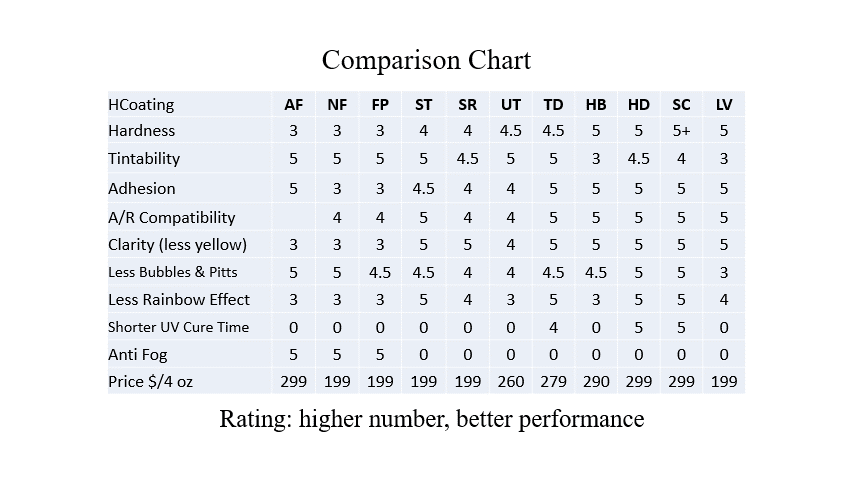
HCoating ST, HD, TD, SC are made from a combination of Intra-Molecular Altering (IMA) technology and Nano technology, resulting
in the UV curable spin hard coatings for eyeglass lenses. Beside superior adhesion, the benefits of new generation coatings are uniform liquid, stable low viscosity, constant spray height, self-defoaming, shorter UV curing time, and reduced rainbow effect.
TD coating is focused on fast tinting. It is the most tintable coating favored by low volume users and small labs.
SC coating is focused on super hardness. It is the hardest coating, designed for high volume users and big labs, within or beyond eyeglasses applications.
HD coating is well balanced between hardness and tintability, favored by big labs in continuous operations.
ST coating is the low cost version of TD, fast tinting, also the most stable coating with longest life in machine operation, extends the life of pump and spindle motor of spin coaters, sets the new benchmark for spin coatings, the most tintable-the most stable-the lowest price-made in USA.
What is the selection guide for the next generation HCoating?
Small labs use one bottle or less of coatings per month. Big labs use more bottles of coatings per month.
In big labs, one coater uses HD or SC coating for non-tinting, and another coater uses TD or ST coating for tinting.
The big labs with only one coater use HD or SC coating.
Small labs use TD or ST coating.
Start with ST coating, change HD for harder coating, SC is the hardest coating. Tinting is decreased accordingly.
What are the recommendations for coating replacements?
Ultra Optics UV-AF to HCoating AF Anti-Fog coating.
Ultra Optics UV-NV, UV-NQ coatings to HCoating ST, SR coatings.
Ultra Optics UV-XBT, UV-87, UV-All coatings to HCoating HD, SR, ST, TD coatings.
Ultra Optics AST-1, AST-2 coatings to HCoating SC coatings.
Coburn ProCoat coating to HCoating ST, SR, TD, HD coatings.
Coburn UVMAX-QT coating to HCoating HD, SR, ST, TD coatings.
Coburn DURA-UV coating to HCoating HD, SC coatings.
SDC CrystalCoat UV CS-NT5 Premium coating to HCoating HD coating.
FSI Technologies Visgard UV Anti-Fog coating to HCoating NF No-Fog coating.
What is the cure schedule for HCoating AF?
Single curing schedule for HCoating AF,
a coated lens is exposed under UV for 30 seconds.
If your UV oven does not fully cure the film, heat the lens at 85C for 15 minutes.
Cover up the coating reservoir when machine is not in operation to avoid picking up moisture from the air.
Why do I get streaks on the lens after mixing HCoating with our pre-existing coating?
Coatings in a coater thicken over time and running the machine will help incorporate the new coating. Streak
appearances indicate that HCoating and the old coating have not yet been well-mixed. Keep running the machine until no
streaks appear on a lens.
Why do I get a milky film after mixing HCoating with our pre-existing coating?
Milky film indicates a parameter difference between the two coatings. Generally speaking, using more than 50% of
HCoating in a mix should avoid any incompatibility with other solvent-free hard coatings.
How do I optimize the coating performance?
If the coating loses adhesion on lenses, which means the dry film is too thick, increase the spin off rpm to get
thinner film. If the coating shows marks or scratches, which means the dry film is too thin, decrease the spin off rpm to get
thicker film. If the coating dry film is sticky, which means under-curing, increase UV exposure time.
How do I prevent the pits from forming on the coating film?
Adjust the coating jet during spray to the height where the coating touches the lens all time, because the coating spray jet might be up and down a bit. Wait for at least two hours. Spray again, and there should be no more pits formed on cured coating film.
Do you have a cleaning method to remove uncured (wet) HCoating?
Method A: Pick up a piece of tissue paper, soak it up with pure IPA (isopropyl alcohol), and then use the wet paper
to wipe the coating off the lens. This may need to be repeated until the lens is free of coatings.
Method B: Smear some liquid soap detergent on the coated lens, then rinse the lens with tap water, or go through
the water cleaning process in your coater.
How to bypass machine QR code controls?
Here are 3 ways to do it:
1. Collect old QR codes unused. Usually, one code works for more than just one bottle.
2. Mix the original brand with a new one. Try mixing them in different ratios - if it doesn't get cloudy or look like milk, they're compatible. If it cures fine without any weird issues, you've passed the test.
3. Mod the machine's program. Then you can use whatever hard coating you want freely.
How do I make an order?
You can contact us through text message, email, WhatsApp, WeChat (WeiXin), and telephone.
How do I make payment to you?
Here are 4 payment methods:
1. Wire transfer takes a few days to reach. You pay bank processing fees.
2. PayPal makes transition instantly. You pay PayPal fees up to 5% depending on originating country.
3. Zelle makes transition instantly without fees, if you have a US bank account. There's a daily limit of under $5,000. For bigger amounts, you can just split it over a few days.
4. Western Union transfer takes days if not over a week.
What is your return policy?
Email us first. We guarantee good quality products upon arrival. Please get our authorization prior to returning any
packages. Shipping charges are nonrefundable.
What is your privacy policy?
We respect the privacy of our customers, and ensure the confidentiality of your personal or
business information, which will not be disclosed to anyone unless required by law.